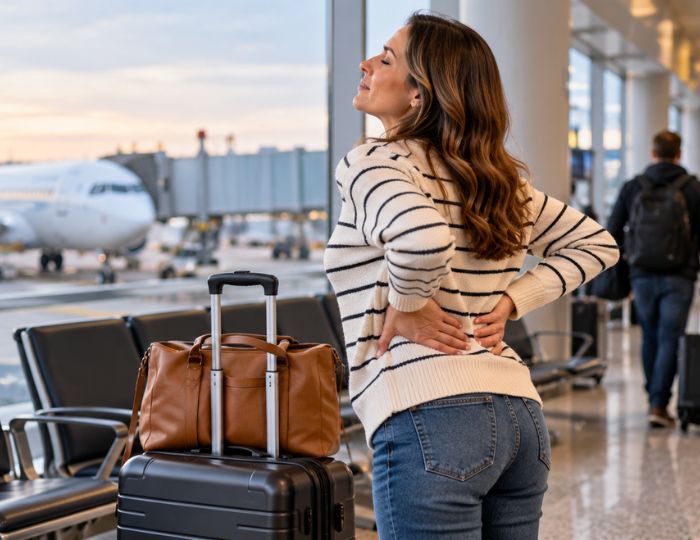
Holiday travel can involve a lot more sitting than most people realize.
You may spend hours behind the wheel, wait at an airport, sit through a long flight, ride in another car after landing, and then spend even more time sitting with family once you arrive.
Add luggage, unfamiliar beds, disrupted exercise routines, and holiday stress, and your back may not be thrilled about the trip.
The good news is that a few intentional habits can make travel easier on your body.
At Family Chiropractic & Posture Center, we emphasize chiropractic care alongside posture and healthy movement habits to help patients better understand how their everyday activities affect their bodies.
Why Long Travel Days Can Be Hard on Your Back
Your body is designed to move.
Travel often asks it to do the opposite.
Long drives and flights can leave you sitting in essentially the same position for hours. Space may be limited, particularly on airplanes, and it’s easy to gradually slide into a slouched posture.
Prolonged sitting can also mean certain muscles aren’t moving through their normal ranges as frequently.
We’ve explored this issue in our article about what sitting all day can do to your body.
The goal during holiday travel isn’t to maintain a perfect position every second.
It’s to avoid remaining in one poor position for an unnecessarily long time.
Start With Your Sitting Position
Before a road trip, adjust the driver’s seat while the vehicle is parked.
You should be able to comfortably reach the steering wheel and pedals without excessively reaching forward or rounding your shoulders.
For passengers, avoid spending the entire trip twisted toward another person or curled into an awkward sleeping position.
On an airplane, options are more limited, but you can still pay attention to how you’re sitting.
Try to avoid constantly leaning forward over your phone or tablet.
Don’t Chase “Perfect” Posture
Posture matters, but the answer isn’t sitting rigidly upright for six straight hours.
Movement matters too.
Even a good position can become uncomfortable when maintained for too long.
Think of healthy travel posture as a combination of supportive positioning and frequent opportunities to move.
Family Chiropractic & Posture Center’s posture resources can help patients better understand why posture is about more than simply forcing the shoulders backward.
Take Movement Breaks When Possible
On a road trip, plan periodic stops.
Get out of the vehicle, walk around, and allow your body to move before getting back on the road.
During flights, movement opportunities depend on safety instructions and the travel environment. When you’re able to move safely, changing positions or walking briefly can break up long stretches of sitting.
Even while seated, avoid remaining completely motionless for hours.
Simple position changes can make a long travel day feel different.
Our article about poor movement patterns and chronic pain provides additional perspective on why the way we repeatedly move—or don’t move—can matter.
Be Careful When Lifting Holiday Luggage
Travel doesn’t only involve sitting.
There are suitcases to move in and out of trunks, bags to lift onto counters, and carry-ons to place in overhead compartments.
Problems can arise when people rush these movements.
A heavy suitcase lifted while twisting or reaching awkwardly can place unnecessary demand on the body.
Move closer to the bag before lifting it. Avoid combining a heavy lift with an aggressive twisting motion. Ask for help with luggage that is difficult for you to handle safely.
Packing lighter can also make the entire trip easier.
You don’t earn extra holiday points for carrying the heaviest suitcase in the terminal.
Your Phone Can Become a Posture Problem
Travel usually means extra phone time.
You’re checking directions, boarding passes, messages, weather, restaurant options, photos, and entertainment.
That can mean hours spent looking downward.
Family Chiropractic & Posture Center has covered this issue in our guide to neck pain from phone use.
Instead of keeping your device near your lap for long periods, bring it closer to a comfortable viewing height when practical.
And put it away occasionally.
Your neck doesn’t need to spend the entire flight looking down at a screen.
Keep Moving After You Reach Your Destination
Arriving doesn’t mean you should immediately transition from the car seat to the couch for another four hours.
After a long travel day, some gentle movement may feel welcome.
Take a walk if appropriate. Move around the house. Resume your normal activity routine rather than becoming completely sedentary throughout the holiday.
Maintaining mobility becomes increasingly important as we age, which is something we’ve explored in our article on why balance and mobility matter more as you age.
Your exercise routine may look different while traveling, but that doesn’t mean movement needs to disappear entirely.
Don’t Ignore Pain That Persists After Traveling
Some temporary stiffness after an unusually long day may resolve once you return to normal activity.
But persistent or significant pain shouldn’t automatically be dismissed as “travel back.”
Pay attention to your symptoms.
Family Chiropractic & Posture Center works with patients experiencing a variety of conditions affecting comfort and movement.
For people who experience recurring issues, a broader evaluation of posture and movement may help identify factors worth addressing.
Our PostureFit Active Care approach also emphasizes active movement as part of care.
Consider Preventive Care Before and After Busy Travel Seasons
Many people only think about their spine when something hurts.
A preventive approach looks at movement, posture, and spinal health before discomfort becomes the only reason to pay attention.
Our guide to the long-term benefits of preventive chiropractic care explains the philosophy behind taking a proactive approach.
If you travel frequently or notice that long drives and flights repeatedly leave you uncomfortable, it may be worth examining your overall posture and movement habits.
Family Chiropractic & Posture Center offers prevention and wellness services designed around proactive health.
Make Your Next Holiday Trip Easier on Your Body
Holiday travel may be unavoidable.
Travel-related discomfort doesn’t have to be treated as inevitable.
Pay attention to how you’re sitting, break up long periods of inactivity when possible, use care when lifting luggage, and avoid spending every idle minute looking down at a screen.
Small decisions throughout the travel day can add up.
If holiday travel consistently aggravates an existing back or neck problem, contact Family Chiropractic & Posture Center to discuss an evaluation.
New patients can also review our new-patient information before scheduling their first visit.
Key Takeaways
- Holiday travel often combines prolonged sitting with luggage handling and disrupted activity routines.
- Remaining in one position for hours can contribute to stiffness and discomfort.
- Supportive sitting is useful, but movement is also important.
- Road-trip breaks can provide opportunities to walk and change positions.
- Heavy luggage should be handled carefully, particularly when twisting or reaching is involved.
- Extra phone use during travel can encourage prolonged downward head positioning.
- Continuing appropriate movement after arriving can help prevent an entire trip from becoming sedentary.
- Persistent or significant pain after traveling deserves appropriate evaluation.
- Preventive attention to posture and movement may be useful for frequent travelers.